

If we take specialist forums, tutorials, or sometimes even bottle labels as an example, everything can feel like a parallel vocabulary—made of technical terms, English expressions, and “formulas” that, if not explained, risk pushing away exactly the people who most need to get closer to this world.
That’s why starting with a glossary isn’t a random choice, but an essential premise: knowing the exact meaning of the most common detailing terms helps you bring order to your approach, avoid major mistakes, and above all interpret every stage of car care in a conscious and correct way.
In this article you will read:
- A necessary (and useful) premise
- Understanding the first 5 terms to preserve the car’s aesthetic value
- The language of five details that truly make the difference
- From theory to practice: now it’s your turn
A necessary (and useful) premise
Detailing is not washing, it is not simple cleaning, and it is not even “just” polishing. This awareness must be solid, because only with it can you move forward through a complex, articulated process based on three pillars: technique, knowledge, and care. And that knowledge begins with terminology.
The first fundamental distinction is between detailing and car wash.
Those who perform a traditional wash generally limit themselves to removing visible dirt and often do it quickly or superficially, neglecting delicate surfaces or using generic detergents. Detailing, on the other hand, is built on a core principle: every material needs a specific product, every surface requires attention, every treatment has a clear purpose and its own timing.
The language of detailing reflects this extreme care: you don’t speak generically about “wax,” but you distinguish between wax, sealant, and coating; you don’t just say “clean the wheels,” but talk about decontamination, brake dust, iron remover. This isn’t pedantry, but necessity: a wrong word can lead to a wrong action, and a wrong action can lead to irreversible damage.
Washing is not enough to have a “clean” exterior surface. Many beginners, for example, start scrubbing with a sponge on paintwork covered in sand or metallic residues, creating countless micro-scratches—often invisible to the naked eye, but devastating for the clarity and gloss of the clear coat.
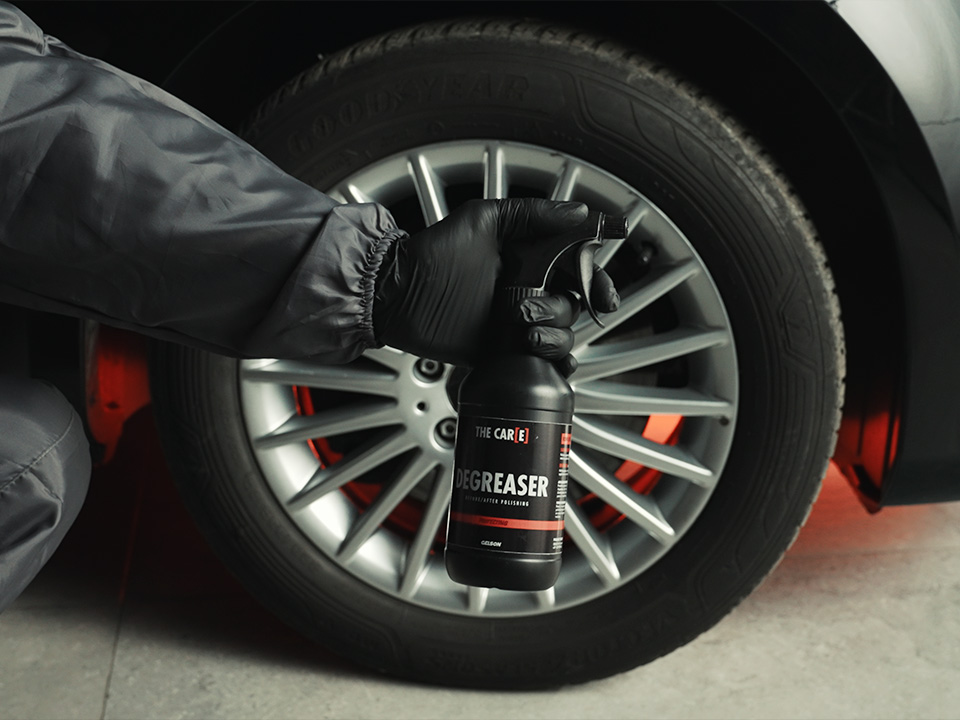
Asphalt residues, iron particles from brakes, resinous pollen, water spots from limescale, or insect remains require specific products—and it’s exactly the terms, the words, that make selection easier and more precise.
Just as important is the language of the interior.
Learning the language of detailing is the first, essential step in transforming simple cleaning into conscious care and into a “mindset”: it means understanding what you are doing, preventing mistakes, choosing products with criteria.
Because even beginners deserve excellent results.
Understanding the first 5 terms to preserve the car’s aesthetic value
After the initial clarifications, it’s time to enter the terminology itself—specifically at the level of protection, a crucial phase to ensure long-term aesthetic and functional results.
In this section we’ll cover five terms every beginner should know before starting: protection, wax, sealant, coating, and beading.
1. Protection
In detailing, the word “protection” has a precise technical meaning. Protecting does not simply mean applying something that “shines” the paint; it means creating a real barrier against external agents: pollution, acid rain, UV rays, and organic residues such as insects and tree sap.
That’s because an effective protection layer reduces surface wear, slows down the appearance of haze, and makes future cleaning easier. Each protective treatment acts like an invisible micro-shield, and—depending on the level of protection you want to achieve—its application is not a one-off gesture, but a periodic process to integrate into your maintenance routine.
2. Wax
Probably the most popular term among non-experts. When people talk about “wax,” they often fall into a semantic mistake: associating it with the idea of polishing or “fixing” paint. In reality, in detailing, wax has a primarily protective function—an effective barrier against light contamination and weather exposure.
There are natural and synthetic waxes, each with different characteristics. Natural wax delivers a warm, deep visual effect that enhances dark colors and creates elegant reflections, but its durability is more limited—generally 4–6 weeks. Synthetic wax is more resistant, less sensitive to high temperatures, and can last two or three months.
It’s essential to remember: wax does not “repair,” it preserves. It should therefore be applied only on surfaces that are already decontaminated and properly dried.
3. Sealant
Often confused with wax, a sealant is a protective formulation based on synthetic polymers, developed to provide longer-lasting protection. The main difference between wax and sealant lies in the molecular structure: sealant polymers bond more stably to the surface, creating a uniform film that can last beyond three months.
Those who use the car daily or expose it frequently to harsh conditions should get familiar with the concept of sealant, because it’s an excellent middle ground between looks and durability. Another important aspect is ease of use: many sealants come in spray format and don’t require long curing times, making them ideal for beginners.
4. Coating
The term “coating” represents a more advanced frontier in detailing, yet beginners should still understand its fundamentals. It is a ceramic or nano-technology-based protective treatment, capable of creating an extremely durable barrier (up to 12 months or more, depending on the product).
A coating often requires careful surface preparation, ideal environmental conditions, and longer curing times. However, once applied correctly, it offers outstanding chemical resistance (acids, alkalis, solvents) and also a degree of physical resistance (light abrasion, heat, superficial marks). The visual result is often more technical: a “glassy” effect—very glossy and uniform—that adds depth to the paint.
5. Beading
One of the most fascinating (and sought-after) phenomena in detailing is “beading”—the formation of tiny water droplets that gather on a treated surface.
Beading is a visual indicator of how effective the protection is: if you see tight, well-defined droplets, the surface is well protected. The opposite—water spreading out into a flat sheet—signals a lack of protection or the need to renew it.
For beginners, recognizing beading is the first step toward “reading” the car’s surface and understanding when it’s time to apply a new treatment cycle. But beading also has a practical function: smaller droplets tend to slide away more easily, reducing water contact time and therefore lowering the risk of stains and streaks.
The language of five details that truly make the difference
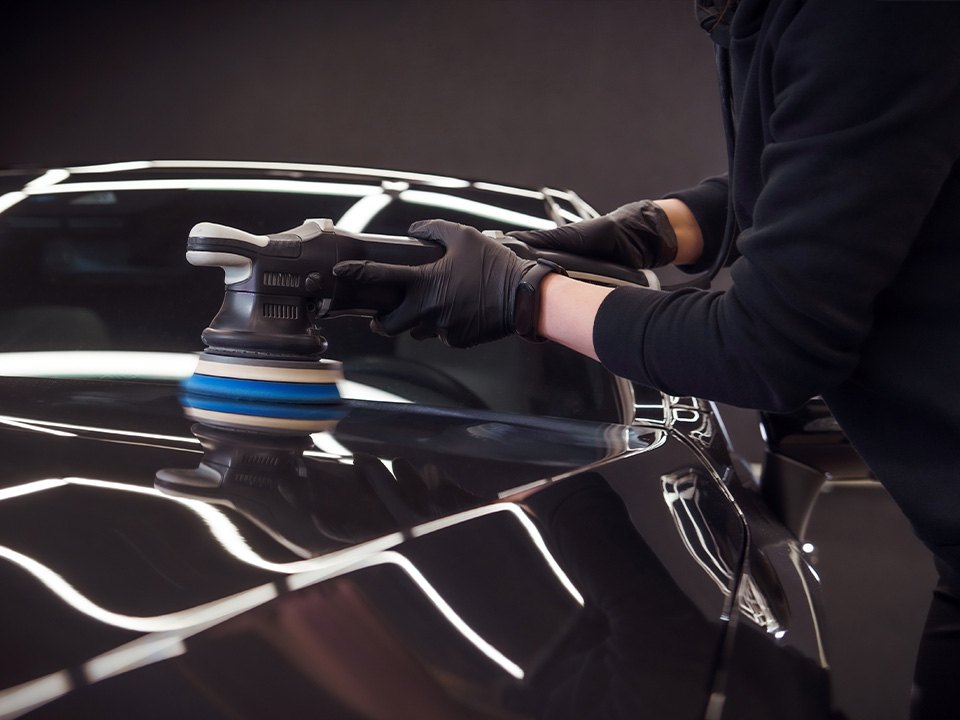
From what we’ve said so far, you can see how detailing is not a simple sequence of steps, but a language learned over time. And it takes time. But one thing is certain: everything starts (again, we repeat it) from understanding the key words.
Another step in this understanding concerns the finishing stage. Here detailing shows its almost artisan nature, where every small action and every tool contributes to a visual and emotional perception of the car: reflections on the hood, silkiness to the touch, chromatic depth.
But to truly get there, you need to know the authentic meaning of specific words. Let’s look at them now.
1. Gloss
“Gloss” refers to surface shine—its ability to reflect light evenly and intensely. But beware: gloss is not a fake, plasticized effect like some low-cost commercial products create.
In detailing, gloss is the outcome of the interaction between perfectly decontaminated, leveled, protected, and refined surfaces. It is an optical quality before it is an aesthetic one.
Gloss is not something you “buy in a bottle”: you build it through the sum of correct treatments. Some protectants enhance it more than others, but without proper surface prep, real gloss will never exist.
2. Finish
Here’s another word that sums up the final appearance of the surface after the full treatment cycle. It is what remains visually—and to the touch—once protectants and finishing products have been applied.
The finish can be glossy, satin, or matte depending on the chosen treatment and the material it’s applied to. Choosing the right finish is partly taste, yes—but also technique. Not everything has to shine: sometimes the most elegant look is a uniform, velvety “matt” effect.
3. Dressing
“Dressing” refers to the final treatment applied to plastics, rubber, or porous materials—interior or exterior—with the purpose of restoring their appearance and protecting them over time. It is used for rubber seals, wheel arches, black trim pieces, and also for tires.
A good dressing not only revives color, but also helps prevent surfaces from cracking, fading, or becoming sticky.
The difference from a simple “shine” product? Dressing penetrates the surface, nourishes it, and evens it out—while a superficial shine tends to fade much faster.
4. Swirl
A seemingly harmless word, but it is the nightmare of every detailing enthusiast. It refers to circular micro-scratches that form on paint due to incorrect washing, rough drying, or using dirty cloths.
They are not as deep as real scratches, but they have the terrible ability to make paint look hazy, marked, and neglected. They show especially in sunlight and compromise the uniformity of gloss. Soft cloths, separate buckets for washing and rinsing, and linear—not circular—movements are basic principles to prevent swirls.
Anyone starting detailing should first learn how to prevent them, and only later—if needed—correct them with proper polish and compound.
5. Microfiber (microfiber cloth)
This is not a product, but the detailer’s true ally. The microfiber cloth is essential for every phase: washing, drying, removing protectants, finishing.
But beware: not all microfibers are the same. There are different weaves (short, medium, or long pile), different weights (GSM), and specific uses. A common beginner mistake is using the same cloth for everything—compromising both effectiveness and safety.
Each stage has its own cloth. The one used for interiors should never be the same used for wax, and certainly not for glass. Never make this mistake!
From theory to practice: now it’s your turn
Great—if you’ve read this far, you’ve surely learned that every action matters: from choosing the right cloth to the application technique, to the order in which surfaces are treated.
But if you want to put into practice what you’ve just discovered, on The Care website you can find everything you need to start on the right foot.
From microfiber cloths that best match your cleaning style, to complete kits for exteriors and interiors, to specific treatments for glass, dashboards, and paintwork.
Choose consciously—learn more in the shop section: protect intelligently, enhance every detail professionally. With The Care, detailing is no longer just for experts: it’s for anyone who loves their car and wants the best—starting now.