
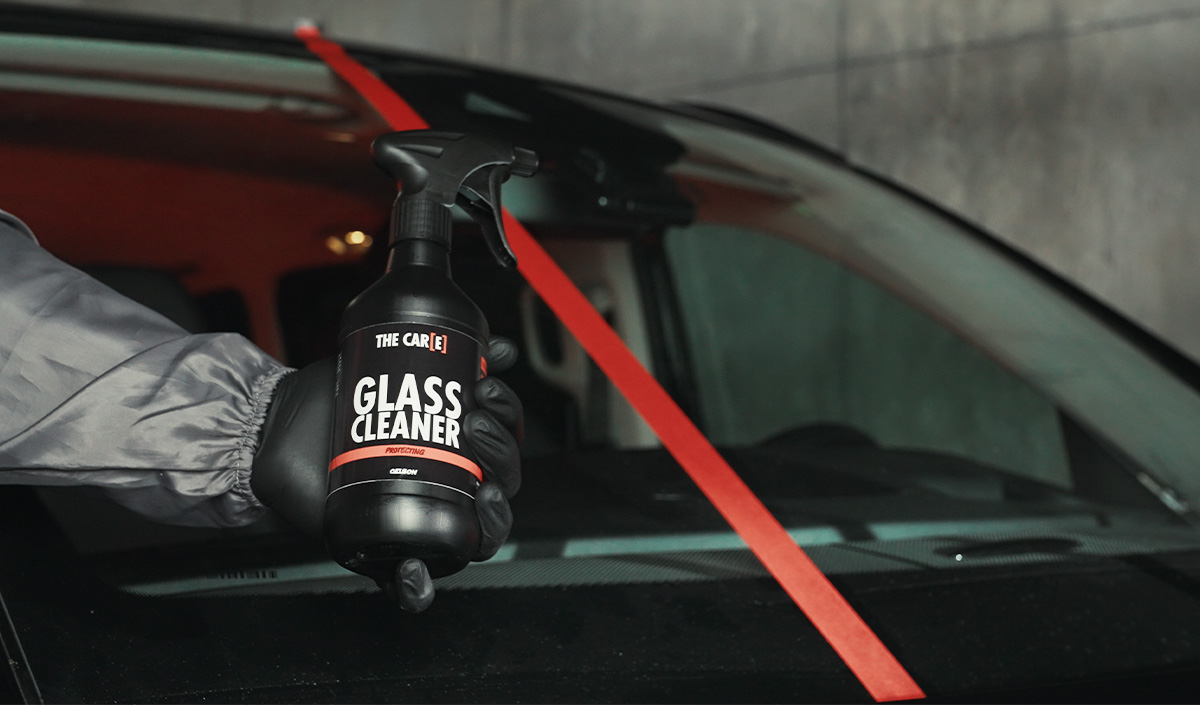
There is one detail more than any other that conveys the idea of a truly well-cared-for car: the glass.
When windows are crystal-clear, with no streaks or reflections, the effect is immediate—quite literally, it catches the eye. But achieving that impeccable transparency is neither as simple nor as obvious as it seems. It takes very little—an unsuitable product, the wrong cloth, a rushed technique—to leave those irritating, unattractive marks behind. And yet, this is not just an aesthetic matter. Clean glass, that lets you see the road properly, is also a concrete way to improve visibility and drive more safely—especially when it rains or in the evening, when other cars’ headlights hit you straight in the eyes. Let’s take a closer look at how you can care for your windows and keep them at their best.
In this guide you will find:
- Preparation for cleaning: the importance of the environment, the surface, and correct product application;
- Finishing techniques and streak removal: how to achieve perfectly transparent glass;
- DIY home remedies vs professional solutions: the value of an intelligent glass routine;
- A new vision of car care: flawless glass, safer driving.
A precise, fast, high-performance routine. Even in your home garage.
Preparation for cleaning: the importance of the environment, the surface, and correct product application
Compared to washing the bodywork or treating the wheels, cleaning a car’s glass can seem like a secondary task. But anyone who has tried driving into the sun with a windshield marked by streaks knows just how essential this step really is.
It’s not only the product you use that makes the process easier. The real difference lies in a set of preliminary precautions which, if neglected, can undo every effort.
Even before cleaning, it’s best to prepare the surface you’re going to treat. Many people make this mistake: working in less-than-ideal environmental conditions.
Often, for convenience or haste, people clean the car’s glass under direct sunlight or immediately after a full wash, when the glass is still damp or warm. Both approaches are counterproductive.
Heat accelerates evaporation, making it difficult to distribute the product evenly and encouraging streaks.
At the same time, residual moisture or water droplets on the surface interfere with the cleaner’s adhesion, compromising its effectiveness. The recommendation, therefore, is to work in the shade—preferably in a garage or during the coolest hours of the day—and make sure the glass is perfectly dry and cool to the touch.
Once the ideal environment is defined, you move on to choosing the tool and product. One recommended option is Glass Cleaner, a high-evaporation formula designed to clean interior and exterior glass deeply and evenly, without leaving marks or oily residue. Unlike many generic glass cleaners—often derived from household formulas or overly perfumed—Glass Cleaner is specifically designed to respect automotive surfaces: it does not damage tinted films, it does not corrode seals, and it dries quickly without streaks or film.
You can apply the cleaner directly on the glass. This intuitive—and correct—habit requires maximum attention, to avoid the product running inward, seeping into window controls, or ending up on the dashboard or seat upholstery. The correct technique is to spray Glass Cleaner onto the surface and also onto a microfiber cloth, preferably Microfibre Cloth orange (short-pile side), which features a fine weave designed not to leave lint or streaks.
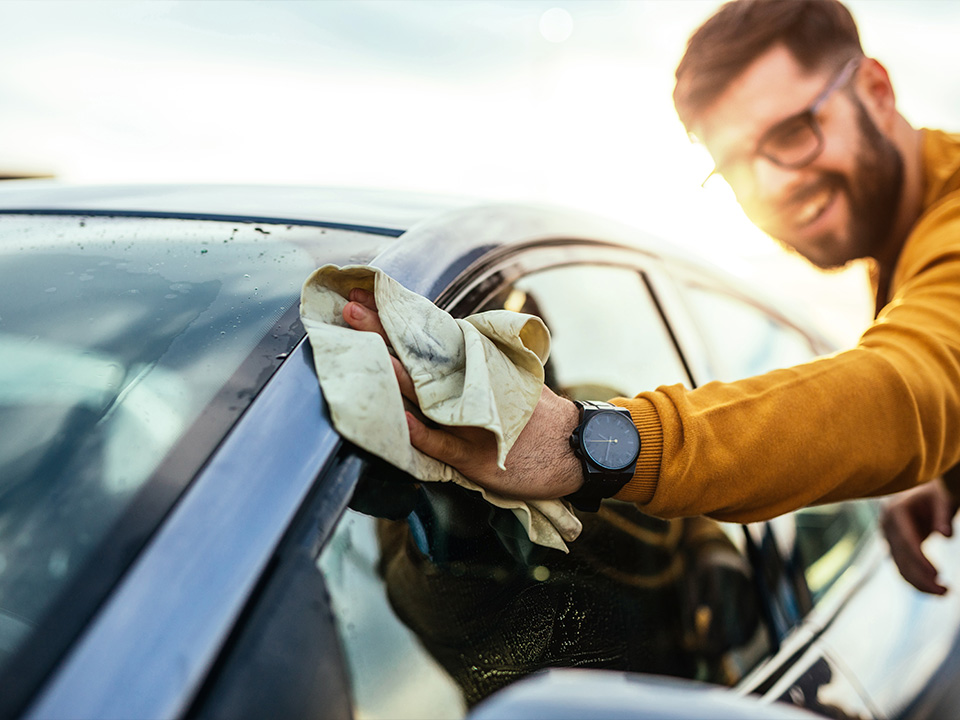
During this operation, you need to press the sprayer decisively and adjust it well so the right amount comes out. For the windshield (front and rear), two or three sprays at most are sufficient. Using too much product makes the cloth overly wet and ineffective. In general, keep a distance of 20–30 cm from the surface and then spray. For finishing, you can use the same cloth, switching to the long-pile side. This cloth is a key element of the procedure: its low-thickness structure allows you to apply uniform pressure across the entire glass surface, preventing the cleaner from being simply “pushed” from one area to another. It also absorbs excess moisture quickly, supporting progressive and controlled drying. Spraying the product directly onto the cloth—with two or three sprays—helps you start with the correct amount of liquid, avoiding waste and ensuring smooth application.
At this point, you begin wiping. Here it’s worth highlighting another common mistake: random, disordered, or overly fast strokes. The ideal approach is a linear, wide, steady motion—preferably horizontal on the outside and vertical on the inside. This simple but extremely effective trick lets you immediately identify which side a streak comes from: horizontal means outside; vertical means inside. This saves time in the finishing phase, avoiding unnecessary passes.
While cleaning, remember to treat not only the central area, but also the perimeter zones—often forgotten—such as corners or lower areas near the seals, where stagnant dust, sealant residue, or condensation tend to collect. Meticulous cleaning also includes the interior rear-view mirror and side windows, which—especially in warmer months—tend to fog up or mark easily.
Investing a few extra minutes in preparation and in applying/removing product pays off in longer-lasting results and a better driving experience.
Finishing techniques and streak removal: how to achieve perfectly transparent glass
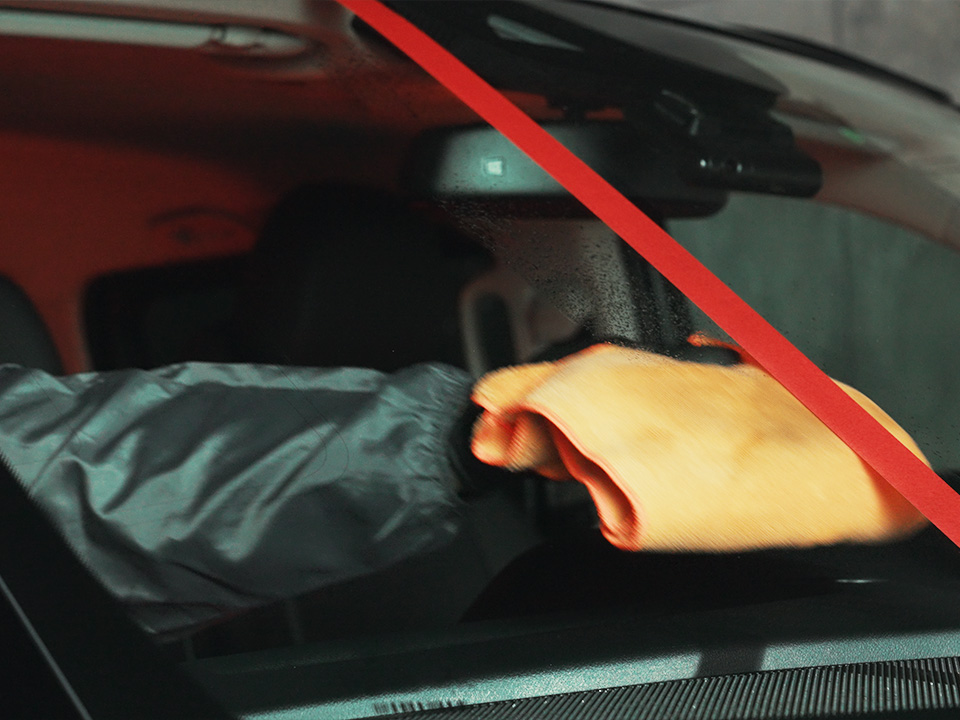
Once application is complete, you move on to drying. Even in this phase it’s essential to avoid generic or multi-purpose cloths: using a second Microfibre Cloth orange, dry and clean, allows you to finish the surface without dragging residues back across the glass. Work with light, crosswise passes, focusing on areas where the glass “resists” the cloth—often a sign that residue is still present. Horizontal movements for the first pass (to pick up excess product), then finish with a series of light, parallel vertical passes to refine and remove remaining streaks. This double direction serves a key purpose: it ensures uniform finishing and provides immediate visual diagnosis. In a few seconds, the glass should appear fully transparent, uniform, and free of streaks.
If you want an even higher level of precision, use a cool-light flashlight or your phone’s light to check for streaks or small imperfections. This is how you achieve a professional result at home, with minimal expense and without machines or aggressive chemicals.
But why do streaks form? The main causes are three, and each has a precise solution:
- using unsuitable products, often generic, alcohol- or ammonia-based: these can include surfactants not suited to automotive glass, leaving greasy film, haze, and persistent spots;
- incorrect drying technique, using dirty cloths, cloths that are too rough, or overly absorbent: the latter tend to retain the product instead of distributing it, generating those frustrating streaks visible against the light;
- unsuitable environment and timing, such as cleaning in full sun or on glass that is still warm: in these conditions, the cleaner evaporates too quickly, without time to act effectively.
The first countermeasure, therefore, is the already mentioned choice of a dedicated finishing cloth. But something people often underestimate is the movement—it should never be random. Another determining aspect is pressure: you shouldn’t press hard, but wipe lightly, letting the microfiber work by capillarity. Rubbing forcefully—especially when the cleaner has not fully evaporated—only redistributes grime rather than removing it. Our suggestion is to use Microfibre Cloth orange, folding it if it becomes dirty and continuing with clean sections only.
The cloth must always be clean and dedicated exclusively to glass. Using cloths previously used on other surfaces (plastics, dashboard, wheels) is one of the most common causes of streaking, due to oily residues contaminating the glass.
It’s also worth noting that many people overlook the role of interior glass in the perception of streaks. The windshield, in particular, tends to collect greasy vapors from a heated dashboard, cigarette smoke, fine dust, and body vapors. These settle slowly but steadily, forming an invisible film that can make the glass hazy or prone to fog. Here the issue isn’t obvious dirt, but a micro oily layer that is “reactivated” by light or humidity. For this reason, it’s recommended to regularly clean interior glass with the same care given to the exterior. In some cases, it’s the interior glass that is the true cause of seemingly “mysterious” streaks.
In difficult weather, a perfectly clean surface also allows the wipers to work more efficiently, avoiding those annoying residual bands that often affect untreated windshields.
Another good practice is to keep a checklist of the steps—as suggested in the strategic content—to print and store in the trunk, listing key points such as: 1) preparation in a shaded environment; 2) preliminary drying of the glass; 3) application on cloth, not only on glass; 4) light, orderly crosswise movements; 5) check with oblique light.
This simple sequence, applied consistently, can solve 90% of glass-cleaning issues.
DIY home remedies vs professional solutions: the value of an intelligent glass routine
Anyone who has cleaned car windows at least once knows how frustrating it can be to achieve a truly satisfying result. It’s easy to fall into the temptation of improvised solutions, trusting household products such as alcohol, vinegar, or common household glass cleaners. However, what seems simple and convenient at first quickly proves ineffective—if not harmful in the long run. That’s why it’s important to clarify the substantial differences between DIY remedies and professional products, not only in terms of finish, but also in safety, durability, and operational efficiency.
Take denatured alcohol, often used as an emergency solution. While it has decent degreasing power, it is excessively volatile: it evaporates too quickly, preventing effective cleaning action. The result? Glass that looks clean, but shows hazy streaks, iridescent marks under direct light, and a surface that tends to attract dust again. Added to this is the side effect of drying out rubber seals, which over time can cause micro-cracks around windshield edges.
Even more insidious is white vinegar, often promoted as a “natural remedy.” While its acidity helps dissolve limescale, it is not suitable for car glass for at least three reasons: it leaves a strong, unpleasant odor inside the cabin; it can interact negatively with tinted films and protective glass treatments; and it is not very effective at removing oils, smoke residue, and pollutants typical of urban environments.
Finally, household glass cleaners are designed for static environments, vertical surfaces, or smooth household window glass. Their formulas often include fragrances, glossing agents, and preservatives that, while pleasant at home, do not evaporate quickly and evenly, creating sticky films that are hard to remove on surfaces exposed to weather or condensation, such as a car’s windows. In addition, their action can be too aggressive—or, conversely, completely ineffective—when faced with specific contaminants like smog, acid rain, or diesel micro-droplets.
All of these limitations are not only about aesthetics, but above all about road safety: driving with less-than-transparent or reflective glass can reduce visual readiness, cause temporary glare, or prevent proper reading of road signs and hazards. Professional products, by contrast, are designed to precisely address the environmental and mechanical conditions a moving vehicle faces.
Another advantage of dedicated products like Glass Cleaner is the ability to incorporate them into a structured care routine that progressively improves glass quality. As with every detailing treatment, glass cleaning benefits most from consistency and periodic repetition.
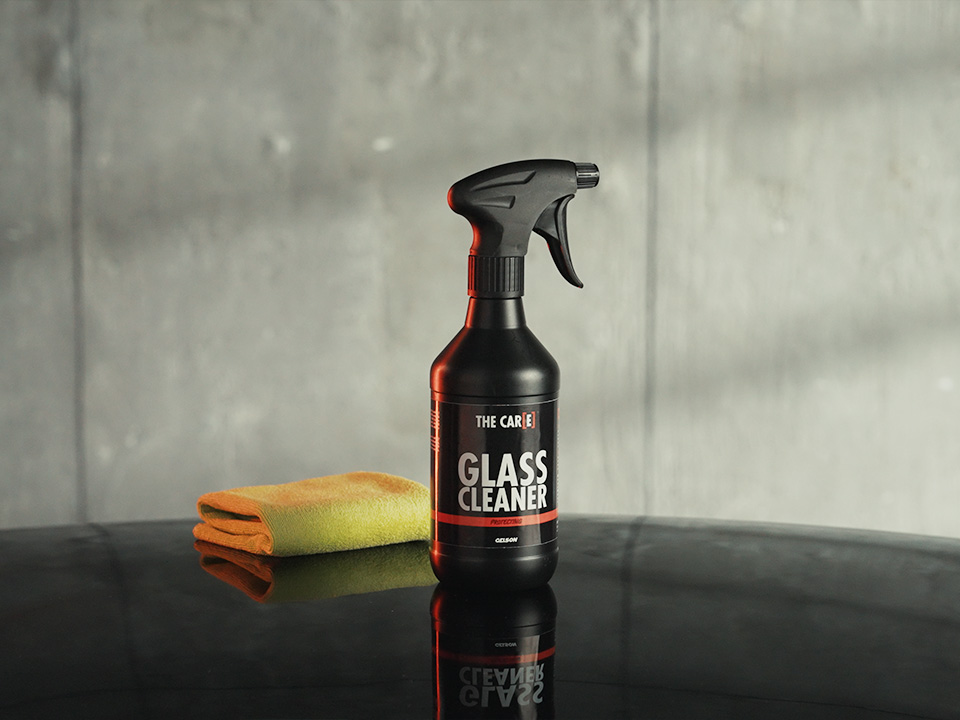
Adopting a regular cadence—every two weeks, for example, or after long journeys—helps prevent layered dirt buildup, reduces the dull “edge effect” that develops along glass borders, and maintains optimal transparency in all lighting conditions.
And there is another advantage not to overlook: the longevity of the cleanliness achieved with a professional product. With the same frequency of use, Glass Cleaner keeps glass cleaner for longer, because its formula avoids dust adhesion and the formation of sticky films. That means fewer maintenance interventions, less cloth waste, and—over time—real economic savings.
In addition, the recommended combination with Microfibre Cloth orange works in synergy, minimizing physical effort while maximizing effectiveness.
A new vision of car care: flawless glass, safer driving
In short, a true democratization of perfection: you don’t need to be a professional detailer or own complex tools—just two elements, a spray and a cloth—and even the everyday driver can reach show-level standards with consistency, precision, and satisfaction. It’s an approach that shifts the concept of “washing” toward a ritual of enhancing the car, where every surface tells the care and identity of the person behind the wheel. Because cleaning glass properly also means seeing the world better: the roads, landscapes, reflections, lights. It restores to every journey—short or long—a visual quality that amplifies the comfort of a healthier, cleaner, more pleasant cabin for yourself and for others.
For all these reasons, The Care confirms itself as a reference point for the modern motorist—focused not only on performance, but also on the balance between functionality, design, and cabin well-being, because in every surface there is a detail that matters.