
But this perception, though understandable, is the first major mistake you need to guard against. Thinking that you can approach this world armed only with goodwill and a bucket of water is like wanting to play a concert grand piano without knowing the notes.
It’s not about “removing visible dirt”, maybe by holding a cloth or spraying a cleaner. Detailing can’t be done in half an hour, and there are no “miracle” treatments that are enough on their own to bring a car back to perfection. Those who approach it with anxiety for an immediate result do a disservice not only to their car, but to the quality of the experience itself.
So let’s see in this guide:
- Before you really start
- Washing isn't enough: the most common practical mistakes that ruin bodywork, glass, and gaskets
- When (ignored) details compromise the final result
- Authentic care, results that remain
Before you really begin
Detailing is often based on a series of misunderstandings. As we mentioned above, one of the worst is the assumption that “washing your car is enough.” But that’s not the only cognitive bias.
Another typical misunderstanding is the idea that it’s enough to “have lots of products” to achieve a professional result. Let’s be clear right away: compulsively piling up bottles, sprayers, and pastes bought online or in supermarkets is a beginner’s syndrome that often creates more confusion than benefits. If you’re one of these people, stop—and don’t charge ahead with the idea that “I’ll buy everything and then we’ll see how it goes.” This way you risk causing damage far more expensive than simple neglect.
There is also an insidious habit, culturally rooted and hard to eradicate: the idea that “DIY” means saving money at any cost. In this case, independence is not an economic shortcut. Those who jump in unprepared with the primary goal of “not spending” end up spending twice as much, between mistakes to correct and surfaces damaged by poorly executed treatments.
Another often unintentional but serious mistake is the lack of a work plan—that is, not establishing a logical sequence of steps to follow. This leads to confusion, going over the same surface multiple times, and compromising the results achieved. Detailing is also a matter of mental order: every phase has its purpose, and disrupting the sequence is like baking a cake and adding the baking powder after it’s already cooked.
And then there’s the most subtle mistake, the one that creeps into your thinking and takes the form of “it doesn’t show anyway.” This is the justification that leads people to skip cleaning the roof, the inner part of the wheels, the black seals, or the storage compartments.
Anyone approaching this world should know it’s not about appearances, but about consciously choosing to give value to every centimeter of your vehicle. If you start with that awareness, you’re already halfway to doing things properly.
Washing isn’t enough: the most common practical mistakes that ruin bodywork, glass, and seals
If the first section helped us expose the false myths and mistaken beliefs that often accompany the first steps in the detailing world, now it’s time to get into the hands-on operations.
And we’ll start with washing the car. In detailing, this is not a rushed or obligatory act, yet many continue to repeat a series of seemingly “harmless” mistakes that, in reality, deeply compromise the outcome.
The first is using only one bucket for the entire wash. It’s one of the most underestimated and at the same time most damaging mistakes. Many beginners fill a bucket with water and shampoo and repeatedly dip the sponge or wash mitt into it, without realizing that each dip carries along sand, dust, and grime collected from the bodywork.
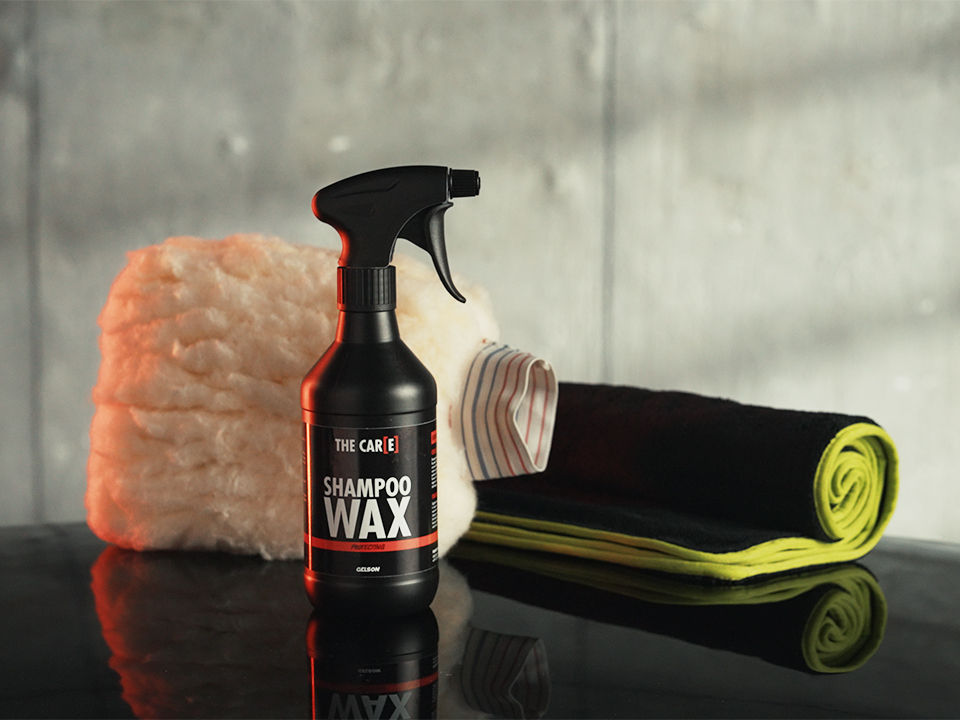
The result? With every pass you rub the surface with an invisible abrasive. That’s how micro-scratches and swirls are created. The golden rule is the "two bucket" method: one bucket with shampoo, the other with water only for rinsing the glove. Even better if you use “grit guard” grids on the bottom of the buckets to trap dirt. It’s always best to use products that are applied directly onto the bodywork or onto a cloth, such as Shampoo Wax, and are not diluted in the bucket. In the latter case, an excellent (but not mandatory) result is to use it with denatured water if you really prefer it diluted—around 30–50% shampoo. In any case, keep in mind that this product is designed to be effective even in small amounts, so it doesn’t end up being an anti-waste trick. With a 500 ml shampoo you can get about 5 full washes!
Along with this comes another frequent mistake: washing the car in the sun. Here too, it’s a “convenient” habit, often linked to available time or space, but it can have harmful consequences. Water dries faster under direct rays, leaving unattractive limescale spots, while detergents evaporate too quickly to work properly, risking residues or even permanent streaks. An effective wash requires shade, cool surfaces, and manageable dwell times. Those who ignore these conditions expose the car to thermal stress and avoidable imperfections. The main issue is that it alters the chemistry of the products, which could even cause spots or dullness. Products react chemically with contaminants, dirt, paint, and generally the surface they are in contact with. A sudden change in temperature—or simply high temperatures—alters the products, compromising their functionality (permanently). Even the bottle itself should not be exposed to direct sunlight for too long.
Another great classic: indiscriminate use of the universal sponge. The sponge, the symbol of DIY car washing, is actually a dangerous tool if used without criteria. Its compact, not very flexible surface tends to hold dirt and distribute it abrasively, without adapting to the car’s profiles. The practically announced and entirely predictable effect is the formation of small grooves, especially in more exposed areas such as hoods, fenders, and doors.
Professionals use microfiber or synthetic wool mitts or cloths, which are much gentler and able to encapsulate dirt without damaging. Using unsuitable cloths compromises even the best product.

Another wrong habit is starting the wash from the top… and then going back down. It seems like a detail, but it isn’t. Car washing has its own sequence: you always start with the wheels, which are the most contaminated areas, and then move up toward the bodywork.Wheels contain ferrous dust and brake-pad residues that, if accidentally carried onto the paint with the glove, can scratch it. In addition, using the same cloth for wheels and bodywork is a serious mistake: you need separate tools for each area, treating critical points with soft brushes, detailing brushes, and specific detergents. Precision, in detailing, is a duty.
And then there’s decontaminazione chimica e meccanica, often completely skipped by beginners. After shampooing, many think the car is “clean” just because it looks shiny.
But in reality, the surface may still be covered with invisible residues: iron, tar, resin, industrial pollutants. Skipping the decontamination step means applying protectants on a surface that isn’t perfectly smooth, compromising both adhesion and effectiveness. The result will be a treatment that “doesn’t last,” that breaks down, or that shows dull areas after just a few days.
In addition, we can’t ignore the mistake of incorrect drying. One of the most neglected moments of washing is precisely the final phase. Many still use cotton cloths or worse, old T-shirts, rags, paper towels. These materials, besides not absorbing effectively, can scratch the paint or leave lint everywhere. Microfiber cloths designed specifically for drying are made to absorb large amounts of water without rubbing: they have dense weaves, finished edges, and superior drainage capacity. Here too, tool quality matters more than people think.
Another recurring mistake is not rinsing detergents properly, leaving residues on plastics and seals. Even the gentlest products, if not removed correctly, can dry out surfaces or cause dullness or areas with visible cracking.
The last mistake to point out is not paying attention to the more hidden details, such as the mirror gaps, window guides, bumper grilles, or the inner edges of the engine bay. Cleaning a car “by sight” is not enough: detailing is, by definition, the art of detail. And anyone who truly wants to learn must accept the idea that, in detailing, there are no shortcuts—only care, consistency, and knowledge.
When (ignored) details compromise the final result
Once the exterior wash is complete and the bodywork is dried, the car is not “detail-ready.” In reality, it’s precisely in the “after”—in the phases following washing—that some of the most serious and underestimated mistakes occur. Paradoxically, the damage doesn’t come only from wrong gestures, but also—and above all—from what you omit, from what you don’t do out of lack of knowledge, laziness, or superficiality. Detailing, we repeat, is not an obstacle course but a marathon of precision: each phase only makes sense if it is completed, enhanced, and integrated into the whole.
Let’s start with a great classic: hasty and incomplete drying. Residual water tends to slip into headlight seams, between seals, around mirrors, and into handle recesses. When, hours later, these residues run down the bodywork, they leave limescale streaks that instantly cancel the visual effect you achieved. The advice is twofold: use a high-GSM microfiber drying towel and blow out remaining water with compressed air or detailing-specific blowers. A simple gesture that makes all the difference.
Next is a more technical but equally widespread mistake: applying protectants on a surface that is still contaminated or damp. You should never let haste take over in car care. Never spray wax sprays or sealants without checking that the car is perfectly dry and fully decontaminated. This causes two problems: on the one hand, the product doesn’t bond as it should and its effectiveness is compromised; on the other, you risk “sealing in” dirt under the protection, creating dullness or stains that are hard to remove. Any protective treatment—whether a wax, a sealant, or a dressing—must always be applied on a surface that is dry, smooth, and microscopically clean.
Another mistake? Using too much product, or too little. Too much creates streaks, lines, sticky residues that are difficult to remove. Too little, on the other hand, makes the effort pointless: the product doesn’t cover the entire surface, leaving areas exposed or unprotected. Every protectant has its own application method and recommended dosage. But above all, you need the patience to spread it with orderly movements, on small sections at a time, and remove it with clean, separate cloths, changing them when necessary.
Another mistake—more “psychological” than practical—is neglecting the interior. Detailing doesn’t end with the exterior: the cabin deserves the same attention. And yet, many beginners limit themselves to wiping the dashboard, spraying an air freshener, and vacuuming the mats. But interior care requires much more. Often you need deep cleaning of air vents, stain removal from fabrics, protection of plastics and leather, and sanitizing the most frequently touched surfaces. Here too, mistakes are often linked to using the wrong products (too aggressive, too oily) or a lack of method (scrubbing without vacuuming, using the same cloth for the whole cabin, applying glossy dressings on reflective surfaces).
To this is added a subtle but decisive mistake: not respecting dwell times or curing times for treatments. You don’t just wait for the protectant “to dry.” Another serious mistake is not having a maintenance routine: detailing doesn’t end in a single session—it’s an ongoing process made of small, regular gestures. Many beginners treat the car once intensively and then forget about it for weeks.
And then there are the “unintentional distractions”: touching the car with dirty hands, placing objects on it, transporting heavy items without protecting the trunk edges, keeping the doors closed for a long time in summer without airing out the interior.
Every small daily mistake, added up over time, turns into visible damage. Wear and tear is not only the result of time, but of wrong choices.
Authentic care, results that last
Detailing (we’ll repeat it again and again!) isn’t just about cleaning or aesthetics—it’s a sign of respect for what you love. It’s a language made of gestures, attention to detail, and consistency that translates into beauty. And if you’ve decided to begin this journey, do it with the awareness of someone who chooses the best, from the very first step.
On the official website of The Care, you’ll find everything you need to turn caring for your car into a ritual of precision: from complete kits for exterior and interior, to professional cloths and solutions to protect, revive, and refine every detail. Discover the nostro shop online.
You don’t need to be an expert. You just need to want to do things well. And we’re here to guide you—with passion, experience, and quality. Whenever you want.